Environment

Waste Resource Utilization
● Strategy: Promote circular reuse of resources, expand waste resource utilization channels, and increase the resource utilization rate annually to achieve the vision of zero waste.
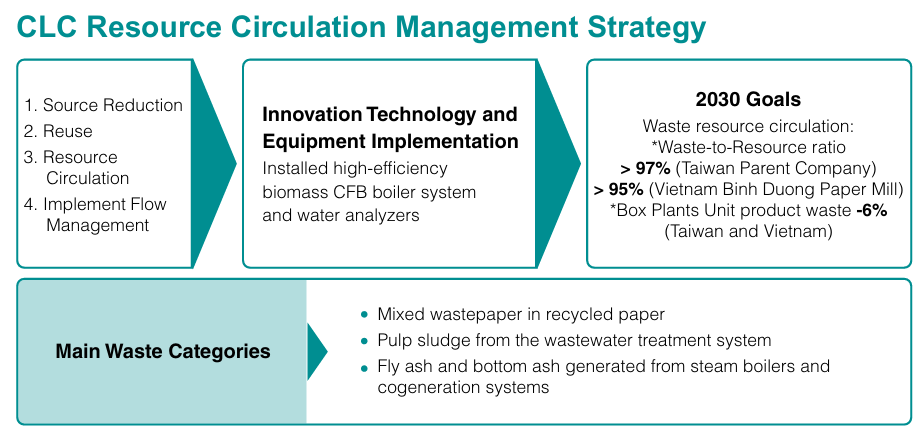
● Goals of 2030:
◆ Waste-to-resources ratio:> 97% (Taiwan Parent Company);> 95% (Vietnam Binh Duong Paper Mill)
◆ All box plants to reduce unit product waste by 6% (base year: 2024;Taiwan and Vietnam)
◆ Advancing Circular Economy in Waste Management
2025 Waste-to-Resources Ratio Exceeded Annual Goals
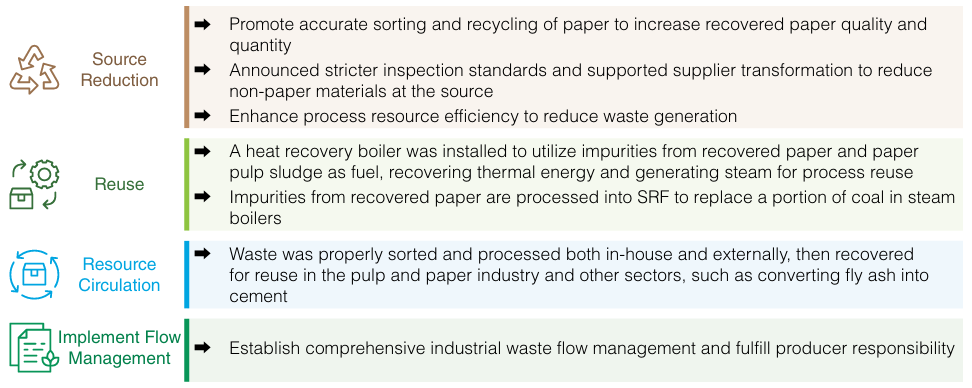
Guided by the principle "no waste, only misplaced resources," CLC manages sustainable resources through 4 core strategies: source reduction, reuse, resource circulation, and flow management. All generated waste is classified as non-hazardous industrial waste, ensuring full environmental compliance and safety.
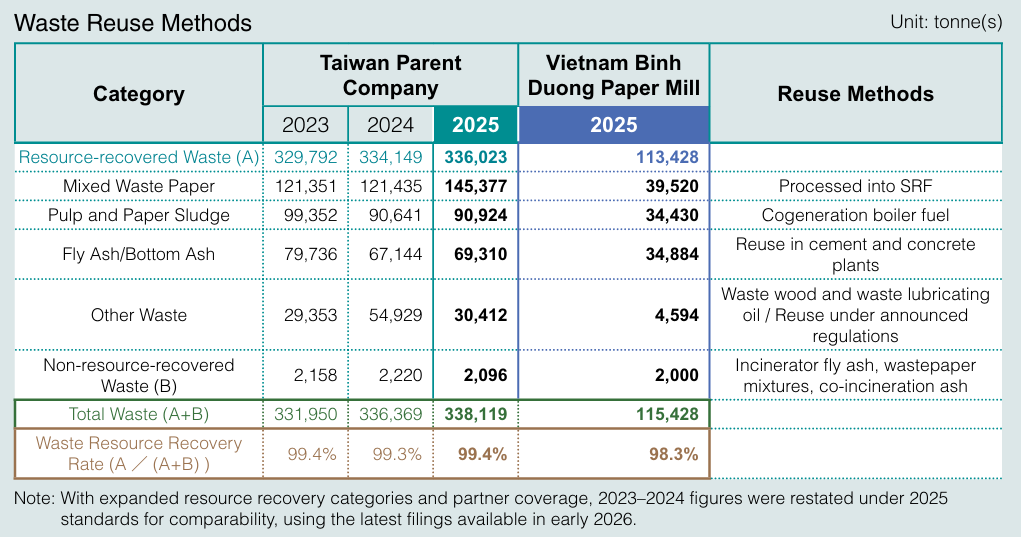
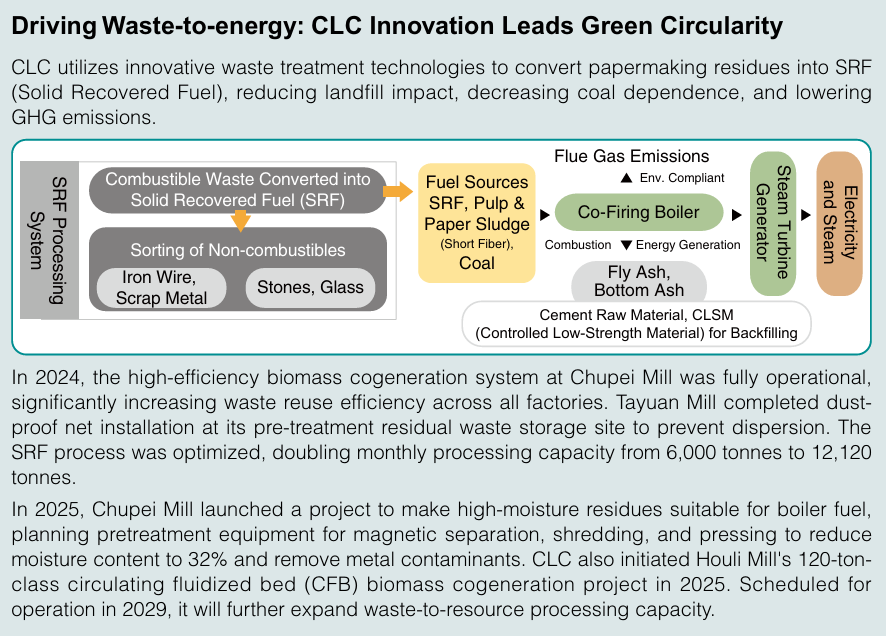
To advance the circular economy, CLC converts process residues into resources and expands the reuse of wastepaper mixtures and co-combustion ash. In 2025, the Taiwan parent company reused 336,023 tonnes of waste, raising its waste-to resources ratio to 99.4% (+0.1 percentage points YoY) and surpassing its 97% target. The Vietnam Binh Duong Paper Mill reused 113,428 tonnes, achieving a 98.3% ratio and meeting its 95% goal.
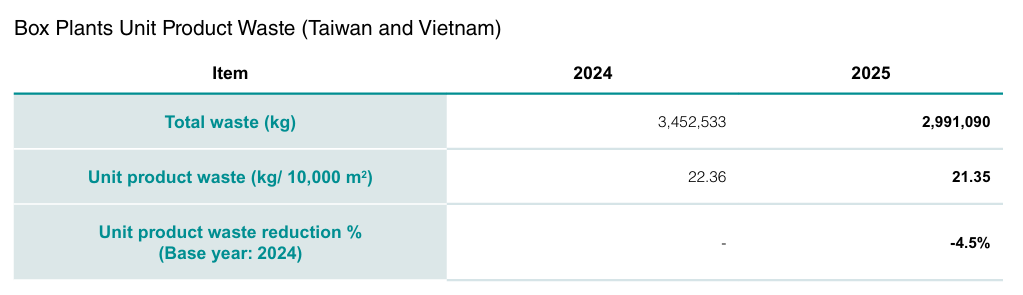
To boost resource efficiency, CLC established a 2030 target in 2025 to reduce unit product waste intensity by 6% across all box plants in Taiwan and Vietnam, using 2024 (22.36 kg/10,000 m2) as the baseline.
This serves as a quantitative benchmark for internal risk control and recycling performance across all sites.In 2025, total box plant waste in Taiwan and Vietnam fell to 2,991,090 kg (a 461,443 kg YoY reduction). Unit product waste decreased to 21.35 kg/10,000 m2 , marking a 4.5% reduction from the base year. Moving forward, CLC will continue to optimize processes, reduce source waste, and enhance resource circulation to steadily achieve its 2030 targets.
Strengthen Waste Flow Management to Ensure Compliance