Environment

Air Quality Management
● Strategy: Reduce air pollutant emissions and improve air quality.
● Goals of 2030:
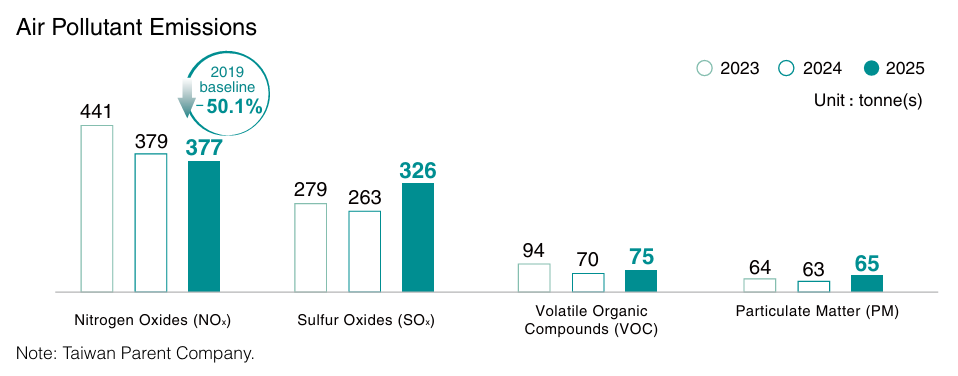
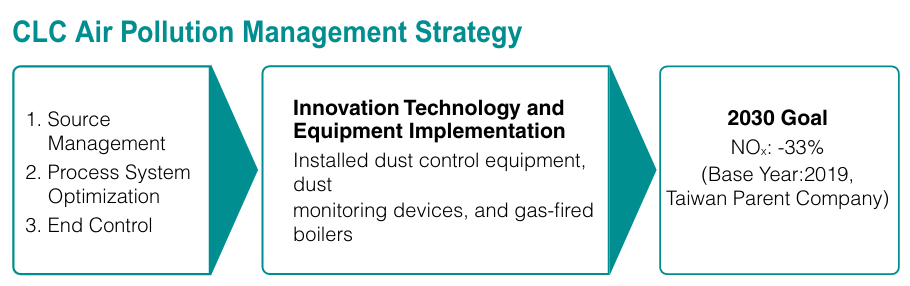
◆ Taiwan Parent Company target: 33% reduction in NOx emission concentration (baseline year: 2019)
◆ No violations or fines related to air pollution or odor anticipated
Strengthening Air Emissions Management and Environmental Compliance
CLC continuously strengthens air quality management by enforcing stricter controls and precise emission source monitoring to reduce air pollution. Major paper mills are equipped with continuous automatic monitoring systems linked to regulatory authorities, ensuring transparent and compliant emission data. Regular inspections of boilers and emission pipelines are conducted to maintain stable operations. CLC implements the following 3 strategies to guide pollution reduction:
• Source Management:Integrate energy resources to reduce coal and heavy oil consumption, minimizing pollutant emissions• Process Optimization:Continuously improve production systems to enhance energy efficiency and reduce pollutant emissions
• End-of-pipe Control: Installation of emission treatment equipment to enhance pollutant filtration and removal capacity
Upgrading Air Pollution Control Facilities
To mitigate air pollution, CLC consistently upgrades its facilities. Key initiatives include constructing an indoor coal yard at the Houli Mill in 2019 to suppress fugitive emissions.
In 2020, CLC enhanced dust control by adding dust control equipment at coal bunker entry points, water mist foam dust removal devices, and a baghouse ash pneumatic conveying system.
Since 2023, our boilers have been progressively equipped with Selective Catalytic Reduction (SCR) systems to effectively lower NOx emissions, backed by regular monitoring and catalyst replacements to sustain control efficiency.
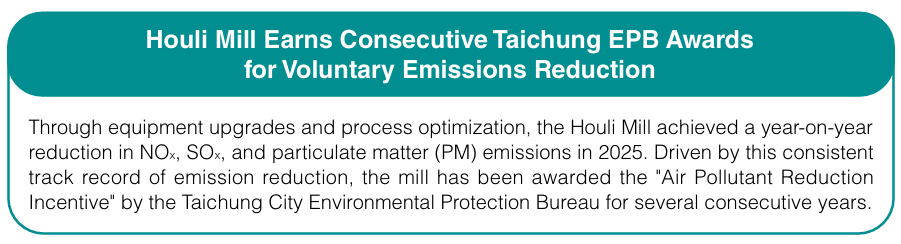
CLC actively enhances air quality through facility upgrades. The Tayuan Mill installed wastewater biogas desulfurization and a 2024 plate heat exchanger to boost exhaust efficiency. The Houli Mill cut SOx by reducing its G2 boiler load and procuring premium coal. In 2025, the Hsinchu Mill implemented 7 optimization measures on its wet FGD scrubber (including adding an acid removal layer, optimizing sieve plates, increasing mist eliminators, upgrading circulation pumps, improving drainage, adjusting pH, and installing automated monitoring). The outcomes included:
• Decreased scaling and clogging, extending tank cleaning intervals from monthly to semi-annually.
• Significant reduction in particulate matter (PM) emissions and minimized fluctuation risks.
Outlook 2026, the company will proceed with the boiler denitrification system replacement at Houli Paper Mill to further strengthen air pollution control and optimize air quality.
1st Paper Company in Taiwan to Establish an Indoor Coal Yard
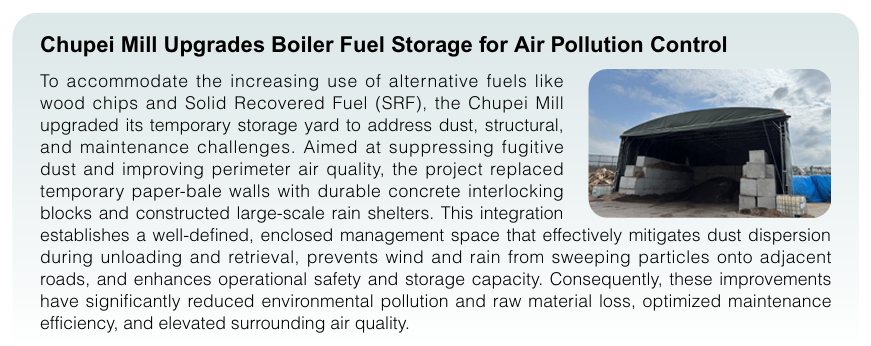
Indoor coal storage facilities reduce particulate emissions and comply with regulations for enclosed structures. CLC Houli Paper Mill and Chupei Paper Mill completed construction of indoor coal yards. Coal silos are divided into 3 zones for separate storage by coal type, enabling allocation and transport based on boiler combustion characteristics. Regular pile turning is conducted to prevent spontaneous combustion.
1st to Replace All Oil-Fired Boilers at Box Plants with Natural Gas Boilers; VOC Source Control to Improve Air Quality
Since 2013, CLC replaced all fuel oil boilers at box plants with natural gas boilers, completing the transition in 2020. This upgrade increased combustion efficiency by over 5%, reduced GHG emissions by 27%, NOx emissions by 63%, and total suspended particulate emissions by 93%Note. These measures significantly reduced air pollutant emissions and fuel costs.
To address potential Volatile Organic Compounds (VOCs) in box plant operations, CLC implements source management by optimizing ink formulas and blending processes to increase water-based and low-volatility raw materials. We have also enhanced equipment airtightness and local exhaust ventilation to curb fugitive emission risks. Combining process improvements with operational oversight ensures VOC emissions consistently remain well below regulatory standards, maintaining a low-pollution production environment. CLC's systematic air quality management has attracted numerous visits from industry, government, and academia, establishing the company as a benchmark enterprise for clean production.
Strengthen Odor Control to Improve Environmental Quality
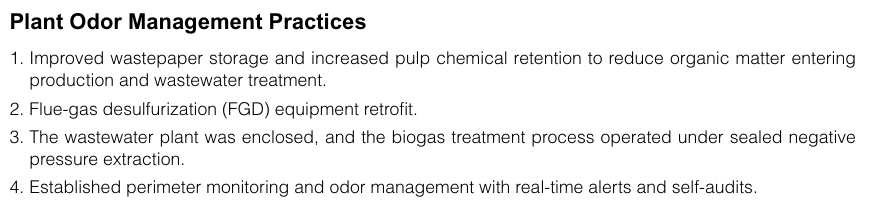
CLC addressed mills/plants odor issues through process and system optimization, achieving measurable results. Each unit identified odor sources and developed odor maps to target mitigation actions. High efficiency air pollution control equipment was installed to reduce odors and pollutant emissions. In 2025, CLC implemented 4 major odor management measures and received no fines related to air pollution odors.