Environment

Nature TNFD & Biodiversity

TOP 1 in Taiwan’s paper industry
Listed at TNFD Early Adopter, Leading Industry Dialogue on Nature-Related Risks
Paper for Nature: Biodiversity Vision
Recognizing that all paper originates from forests, CLC champions the "Secondary Forest" concept by actively promoting resource circulation and sustainable procurement. Consequently, over 90% of our products are manufactured from recovered fiber, complemented by 100% FSCTM-certified sustainable wood pulp. By integrating green principles into product R&D, we deliver sustainable value and provide eco-friendly choices for consumers.
Adopting TNFD to Strengthen Nature-related Risk Governance
TNFD Governance Structure
To proactively address the impact drivers and dependencies of our operations on natural capital, CLC focuses on the following 4 dimensions as our strategies for nature management:
●Avoided Loss:Optimize resource efficiency to minimize the consumption of raw materials, water resources, and land use.
●Threat Reduction:Monitor and mitigate the potential impacts and risks of operational activities on ecosystems.
●Uplift:Enhance positive contributions to nature and biodiversity through restoration, eco(-friendly) management, and innovative actions.
●Maintenance:Establish long-term management mechanisms to ensure the stability of natural capital and ecosystem services.
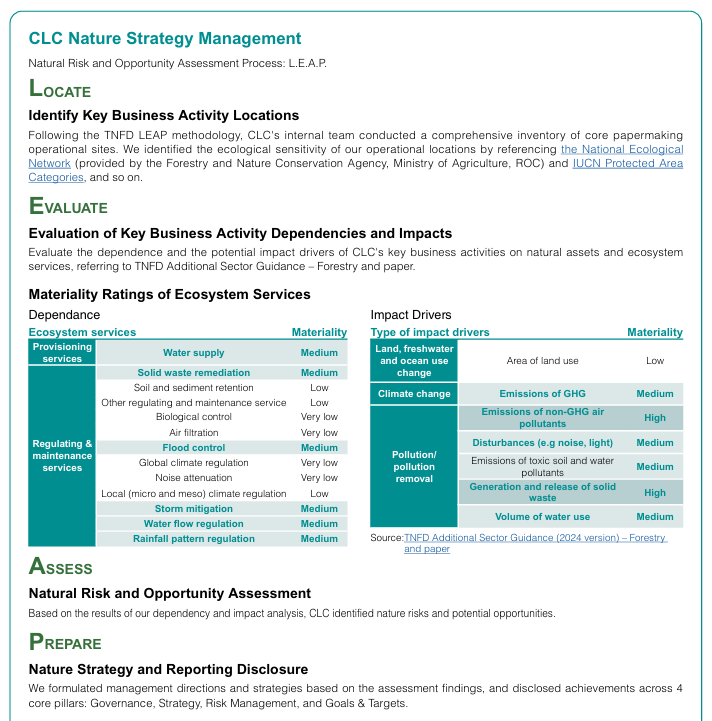
*Source:
the National Ecological Network (provided by the Ministry of Agriculture)
IUCN Protected Area Categories
TNFD Additional Sector Guidance (2024 version) – Forestry and paper
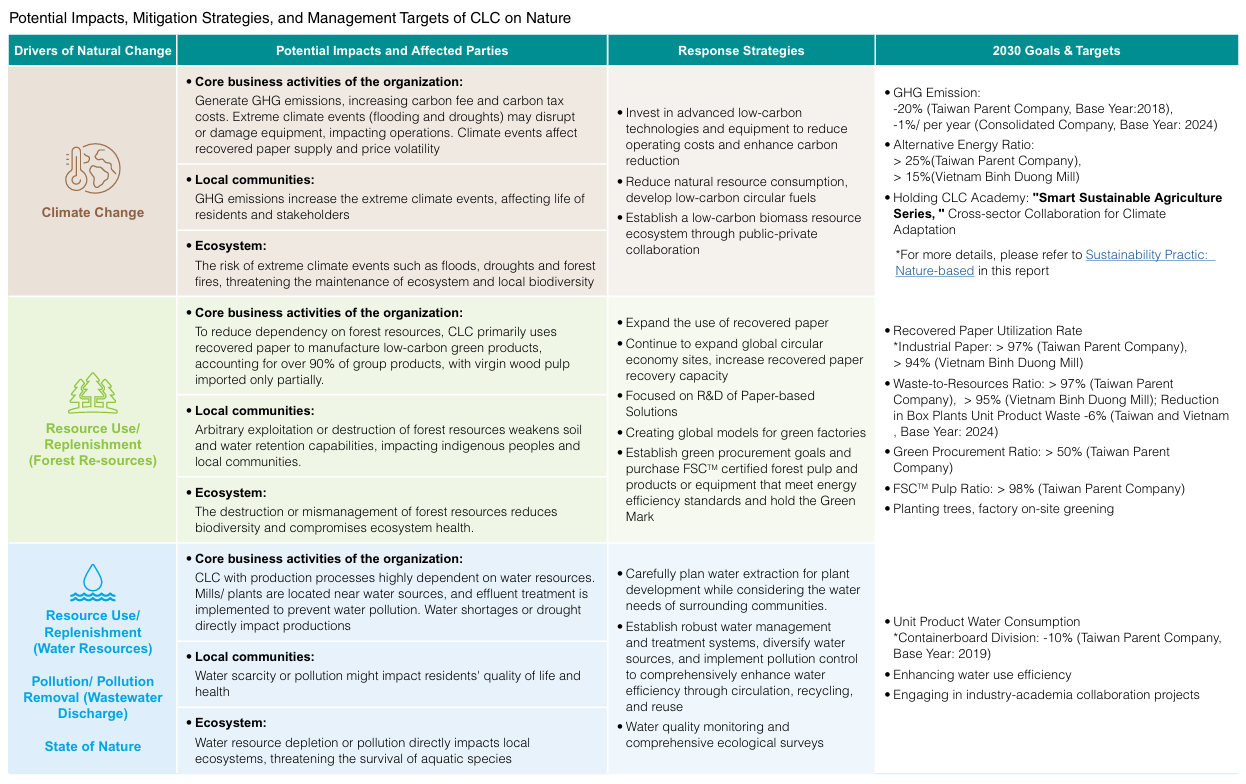
CLC Biodiversity Policy and Commitments
1. Prioritizing habitat protection and restoration:In land management and afforestation, we prioritize protecting original habitats, restoring damaged landscapes, and enhancing ecosystem functions.
2. Science-based management:All ecological surveys, monitoring, and restoration activities utilize scientific methods and are conducted by professional organizations for long-term monitoring.
3. Conservation of protected species:We ensure that habitat environments for Class II and III protected species within our operational or collaborative areas are maintained or improved, avoiding any additional threats.
4. Transparent disclosure:We regularly disclose biodiversity survey results, afforestation benefits, and management outcomes in our sustainability reports.
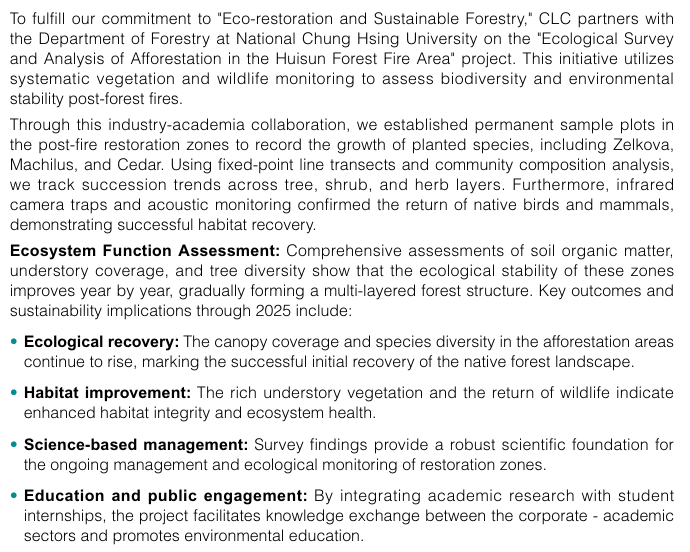
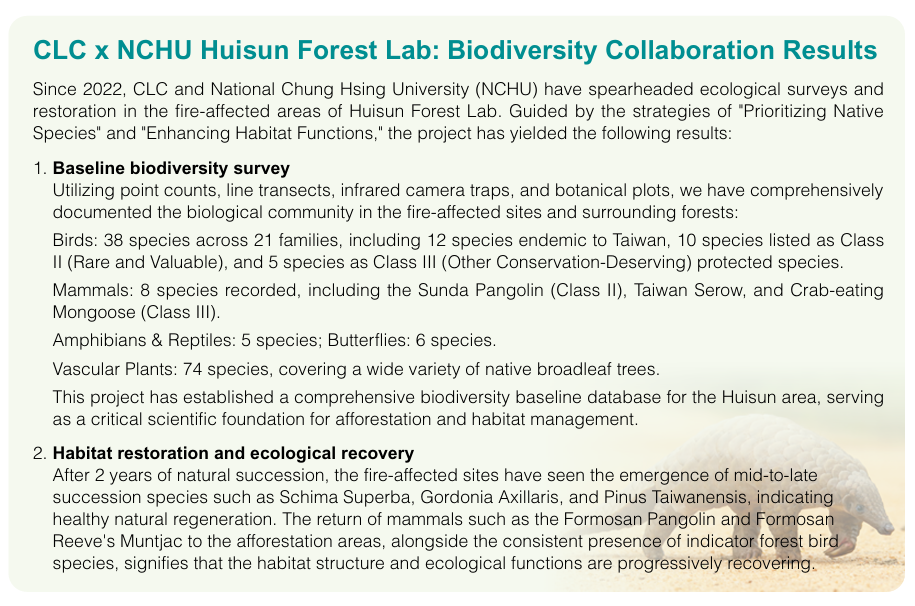
CLC's Nature-based Carbon Sink Strategy
To align with our corporate Net-zero commitment, support the national Net-zero roadmap, and fulfill TNFD requirements regarding the disclosure of natural resource dependencies and impacts, CLC actively promotes Natural Carbon Sink management. By integrating industry-academia collaborations, we strengthen scientific monitoring and sustainable management through the following strategic approaches:
1. Promoting native species afforestation and forest restoration:Aiming to enhance carbon sequestration and ecosystem integrity, we prioritize afforestation and restoration in disturbed or degraded areas.
2. Scientific monitoring of carbon sink benefits:We evaluate changes in carbon sinks through systematic botanical plots, forest structure surveys, natural regeneration monitoring, and habitat change analysis.
3. Adopting ecological engineering to avoid monoculture:We implement mixed afforestation of native broadleaf and coniferous trees to maximize carbon sequestration capacity while enhancing habitat biodiversity.
4. Establishing sustainable forest management models:Through long-term collaboration with academic and research institutions, we continuously update ecological and carbon sink monitoring data within our forest restoration zones.
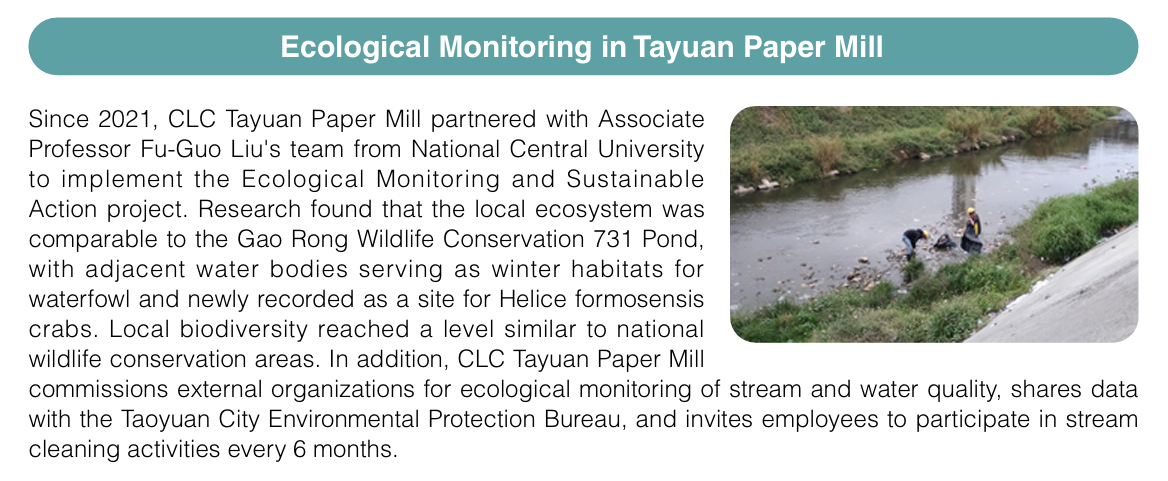
Streams and Wetlands
CLC has implemented ISO 14001 at all domestic and overseas mills/plants and adopted PDCA water resource management to ensure compliant effluent discharge. Stable water sources are maintained for nearby streams and wetlands to support biodiversity. Water conservation and graded water usage management are executed through water resource strategies and inter-plant collaboration. CLC prioritizes ecological conservation near its mills/plants. Additionally, Tayuan Paper Mill and Hsinchu Paper Mill have long-term river adoption programs and organize Water Environment Patrol Teams with employees and local residents for monthly stream patrols, maintaining the Qiaxi River section and Keya River basin during holiday.